

2025 was a landmark year for the Balanced Supply of Housing. Following the renewal of our CMHC-SSHRC funding for the next three years, we deepened our work across all three core research areas: Innovating Responsive Land Use Practices, Reshaping the Financialization of Housing, and Designing Sustainable Housing Futures. From completing our CLT policy paper series to presenting research at the National Housing Council’s Neha Panel, our work has shaped policy conversations from community organizations to every level of government. Read on for highlights from our research and knowledge mobilization activities this year.
Research
This year, BSH advanced significant research across our three core areas, with major contributions to understanding Community Land Trusts, housing financialization and evictions, and the housing needs of vulnerable communities.
Innovating Responsive Land Use Practices
Completing the CLT Policy Paper Series
This year marked the completion of our Policy Report and Profile Series on Canadian Community Land Trusts—the first of its kind in Canada—developed in partnership with the Canadian Network of Community Land Trusts (CNCLT). The six-part series provides critical insights into the principles, practices, and challenges of CLTs in Canada, culminating in Dr. Kuni Kamizaki’s comprehensive synthesis report, A Case for Community Land Trusts in Canada.The series also includes: Reclaim, Remain (Nat Pace & Jane O’Brien Davis) documenting six BIPOC-led CLTs; CLT Definitions (Meagan Auger) exploring legal frameworks globally; More Than Just Affordable Housing (Margaret Low & Tiana Lewis) on Indigenous CLTs, Land Back, and healing; CLTFBC Case Study (Penny Gurstein) on BC’s cooperative housing model; and Responses and Resistance to Gentrification (Susannah Bunce & Emma Ezvan) on how CLTs counter displacement.
Dr. Kamizaki’s synthesis report arrived at a critical moment: approximately 45 CLTs now exist across Canada, with more than 60% emerging in just the past five years. The report outlines eight policy recommendations spanning all levels of government, including: integrating long-term affordability requirements, supporting BIPOC-led CLTs as part of reparation and reconciliation, developing intergovernmental housing acquisition programs, and establishing a new legal framework recognizing CLTs as distinct charitable organizations. With the swell of new building acquisitions amongst our CLT partners, these recommendations provide a clear path forward to ensure the long-term viability of projects that can provide affordable housing in perpetuity.

A huge thank you to everyone who made this series possible, especially project lead, Dr. Susannah Bunce and CNCLT Network Director, Nat Pace.
2025 CLT Summit
BSH continued strengthening Canada’s community land trust ecosystem through collaboration with the Canadian Network of Community Land Trusts (CNCLT). In September, BSH was a proud sponsor of the 2025 CLT Summit in Halifax Under the theme Land is Liberation: Centring Indigenous and Black Land Stewardship; Building Grassroots Power, the Summit featured practitioner labs for technical skill-building, sessions on rental acquisitions and co-operative housing, and field trips exploring local CLT and land back initiatives. BSH researchers presented findings from our Policy Report & Profile Series, bringing rigorous research directly to practitioners and policymakers. For those who couldn’t attend, recorded sessions are available via the Canadian CLTs YouTube channel.


Strengthening our CLT Network
This year reinforced what we’ve always known: community drives research impact at the local level. To this point, we expanded our partnerships with three innovate CLTs reshaping the community land trust landscape: Downtown Eastside Community Land Trust, Hogan’s Alley Society, and Toronto Chinatown Land Trust. These organizations, which have been integral to our research series, demonstrate what meaningful reparation and reconciliation look like in practice. We’re honoured to support their continued work.
We’ve also welcomed Professor Yaëll Emerich, Research Chair in Transsystemic Property and Sustainable Communities at McGill University, to the BSH Node. Her expertise in comparative and transsystemic property law brings new perspective to CLT structures, particularly in Quebec where “social trusts” (fiducies d’utilité sociales) are gaining momentum.
Reshaping the Financialization of Housing
Evictions in the Greater Toronto Area
Our Filling the Gaps project released major new findings on evictions and housing financialization. Sean Grisdale’s report, Filling the Gaps: An Analysis of Eviction Filings in the Greater Toronto Area from 2010–2021, analyzed over 385,000 eviction filings across a 12-year period which revealed how treating housing as a financial asset means more evictions for the most vulnerable.

Key findings include:
• financialized landlords consistently file the most evictions across all periods, including during COVID-19;
tenants in majority-Black and
• racialized neighbourhoods with financialized landlords were three times more likely to experience eviction filings than the average Toronto renter;
• no-fault evictions grew from less than 10% of total evictions in 2010 to nearly 25% by 2021, many of which correlated strongly with housing price increases during the same period.
The findings provide clear cause for targeted policy interventions: stronger tenant protections, limits on no-fault evictions, and measures to slow the financialization of existing rental housing.
Non-Profit Housing Production in Montreal
In Montreal, BSH community partner Vivre en Ville released Tools for Overcoming Institutional Barriers to Non-Profit Housing Production (Mongrain et al., 2025), documenting the systemic financial and institutional constraints facing non-profit builders after the end of Québec’s AccèsLogis program. The report offers concrete recommendations, from reliable pre-development funding to metropolitan-scale planning and zoning tools, aimed at restoring the sector’s ability to deliver deeply affordable supply at scale. (La version française est disponible aussi).

Designing Sustainable Housing Futures
Housing and Gender-Based Violence
Our research on Re-evaluating National Occupancy Standards, conducted in partnership with the BC Society of Transition Houses, continued to inform advocacy throughout the year. The Finding Room for Families report demonstrates how National Occupancy Standards, originally designed to measure housing suitability, have become rigid eligibility criteria that create significant barriers for survivors of gender-based violence.
In a 2022 survey, 96% of BCSTH members reported that NOS negatively impacted the women they serve. The standards routinely force survivors into overcrowded, unstable, or unsafe conditions, with some families waiting years for units deemed “suitable” while having nowhere safe to go.
Dr. Alina McKay presented these findings at multiple venues this year, including the Neha Panel oral dialogue and Housing Central, contributing to the National Housing Council’s recommendation for regional protection measures. The research makes clear that a national alternative to NOS is urgently needed to ensure that survivors of gender-based violence have access to safe and affordable housing.
Accessible Housing Needs
BSH’s work on accessible housing needs in Canada continues, deepening necessary research and centering lived-experience expertise. Our May webinar, The Right to Accessible Housing: Identifying Needs and Building the Right Supply, explored housing rights for people with disabilities—work that also informed Dr. Alexandra Flynn’s testimony at the Neha Panel on housing as a constitutional obligation.


Confronting Sweeps (Housing Research Collaborative)
In June, BSH-affiliated researchers contributed to Confronting Sweeps: Reimagining Advocacy for Tent Cities, a report emerging from a June 6, 2025 workshop hosted by the Housing Research Collaborative. The workshop brought together legal scholars, frontline advocates, community organizers, and people with lived experience to examine how bylaws, zoning, and ‘sweeps’ displace unhoused residents while failing to meet basic needs and brainstormed practical, rights-based alternatives for better municipal decision-making.
Knowledge Mobilization
In support of our research, BSH engaged in extensive knowledge mobilization activities throughout 2025, sharing findings with policymakers, practitioners, and communities across Canada.
In partnership with Spacing Radio, The Overhead released six new episodes exploring Canada’s affordable housing crisis through in-depth conversations with researchers and practitioners.

Episode 10: Security for Renters (February 4) examined why security of tenure matters for renters and their communities, featuring Dr. Alina McKay and Sean Grisdale on eviction research.
Episode 11: Tracking Evictions Across Canada (February 25) explored how provincial differences in eviction law shape outcomes for renters, with Dr. Alexandra Flynn and Dr. David Wachsmuth who found that one-third of evicted Canadians in his study ended up homeless.
Episode 12: The Housing Crisis in Trump’s America (March 14) looked south of the border with Tim Thomas of UC Berkeley’s Urban Displacement Project to examine what Canada can learn from US housing politics.
Episode 13: Non-Profit Housing and Gentle Density (June 13) featured Adam Mongrain and Ines Zerrouki from BSH partner, Vivre en Ville, on how non-profit housing creates deeply needed affordability, alongside Dr. Nik Luka and Conrad Speckert on missing middle housing solutions.
Episode 14: Indigenous-led Housing (October 28) asked what housing by and for Indigenous people looks like, with Dr. Maggie Low, Dr. Alexandra Flynn, and Bailey Waukey, from BSH community partnerAHMA, discussing zoning, governance, and youth-identified housing needs.
Episode 15: Decommodifying Housing (December 12) tackled whether housing can truly be removed from speculative markets, featuring Dr. David Wachsmuth and Dr. Leila Ghaffari on the political economy of housing financialization.
Listen to all episodes on our website.
Research in Progress Webinars and Events
BSH hosted six Research in Progress webinars this year, sharing ongoing work with community partners, housing organizations, and policymakers. Recordings are available on each event page.


Holding Ground: BIPOC CLTs and Resisting Gentrification (March 19) featured insights from newly published CLT reports.
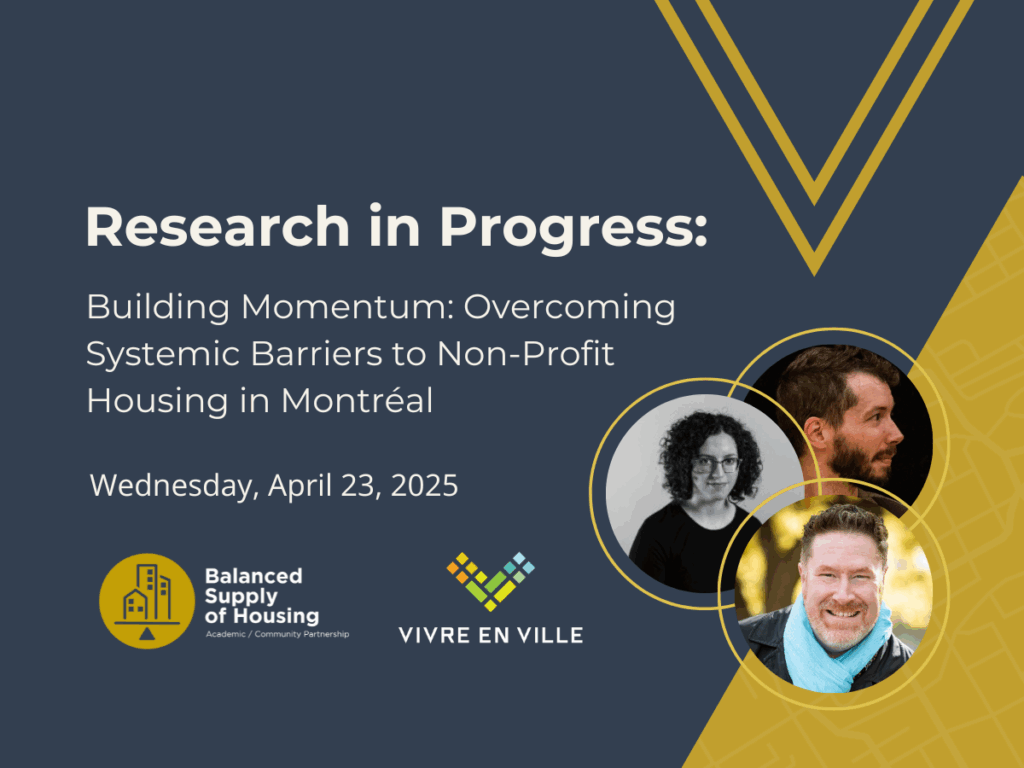
Non-Profit Housing in Montreal (March 26) examined institutional barriers facing the non-profit housing sector in Quebec.
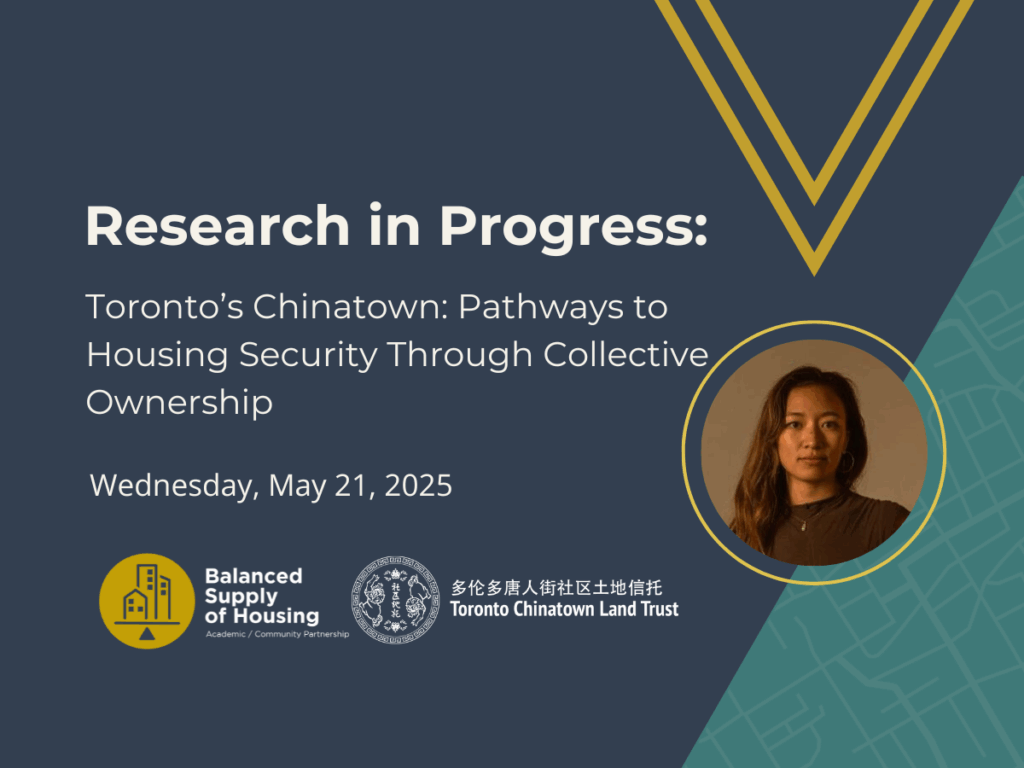
Housing Security Through Collective Ownership in Toronto’s Chinatown (April 22) explored how collective ownership models can protect affordability and cultural community in rapidly changing urban neighbourhoods.
The Right to Accessible Housing (May 23) centered lived-experience expertise on accessible housing needs in Canada.
Vancouver’s Growing CLT Movement (October 22) brought together several BSH partners in the CLT movement to discuss how Vancouver CLTs are reclaiming land and preserving affordability.
Le Dernier Flip Screening and Panel (October 30, Montreal) featured a documentary screening followed by a panel on CLTs and Social Utility Trusts with Montreal-based BSH researchers and community partners.
Major Conference Appearances
National Housing Council’s Neha Panel
BSH experts testified at the National Housing Council’s Neha Review Panel—named from a Kanien’kéha-Mohawk word meaning “our ways”—which examined the right to safe, adequate, and affordable housing for women, Two-Spirit, and gender-diverse people.
Three BSH-affiliated experts presented: Cheryll Case (CP Planning) highlighted the crucial role municipalities play in planning and approvals; Dr. Alina McKay presented findings from Finding Room for Families, calling for federal, provincial, and municipal collaboration through Build Canada and unlocking public land for non-profit development; and Dr. Alexandra Flynn emphasized that housing for people with disabilities must be recognized as a constitutional and international legal obligation.
The panel’s final report is titled “We are human. We deserve a place to live. It’s that simple.” Read our full reflections on the Neha Panel.
Canadian Alliance to End Homelessness (CAEH) Conference
In October, BSH researchers participated in the Canadian Alliance to End Homelessness conference, presenting research and connecting with hundreds of practitioners and policymakers working to end homelessness across Canada.
The conference opened with sobering data: homelessness has doubled across Canada from 2018 to 2024 according to Point-in-Time counts. On a single night, over 67,000 people experience homelessness across the country. Among those experiencing homelessness, Indigenous peoples comprise one-third of respondents despite representing just 5% of the general population. Crucially, 28% of people experiencing homelessness had also experienced an eviction—demonstrating the direct pipeline between housing instability and homelessness.

BSH hosted a panel on systems-level solutions featuring four researchers: Ines Zerrouki tackled non-profit housing barriers in Montreal; Nat Pace presented on the CLT model as strategic defense; Dr. Nik Luka argued for empowering municipalities differently; and Erika Sagert emphasized that non-profits must diversify revenue streams without letting governments off the hook. Read our full reflections from CAEH.
Housing Central
In November, the BSH team attended Housing Central, BC’s annual affordable housing conference, where we moderated panels, presented research, and connected with sector partners.
Dr. Alina McKay moderated a panel on Community Land Trusts, bringing together leaders advancing the model in Vancouver: Djaka Blais (Hogan’s Alley Society) shared how land trusts can rebuild communities and restore generational wealth lost to displacement; Andy Bond (DTES CLT) explained their work protecting affordability in the Downtown Eastside; and Dr. Maggie Low highlighted rising interest in Indigenous Community Land Trusts.
On the conference’s final day, BSH brought together academic researchers including Dr.Carolyn Whitzman (UofT) and Dr. Nathan Lauster with community partners including AHMA’s Research Director, Jena Weber and First United’s Director of System Change and Legal, Sarah Marsden for a forward-looking panel discussion about Canada’s housing future.
What resonated most was that without stronger federal leadership and real accountability, Canada will continue managing crisis rather than solving it. As the country approaches the end of the National Housing Strategy, the path forward is clear: scale up proven social housing and prevention models, operationalize the right to housing—especially for Indigenous communities—and confront the fact that our housing outcomes are the result of political choices.

Alexandra Flynn Championed Housing Rights at Home and Beyond
This year, BSH Director, Dr. Alexandra Flynn continued to advocate for the right to housing, emphasizing how housing needs should shape policy, advocating for a closer look at community land trusts to offer affordable housing solutions, and reiterating that the law must uphold the right to shelter.
Her advocacy took her across Canada and internationally—she attended the Encampments and the Charter workshop, held in Edmonton, exploring the legal and social dimensions of housing encampments. She was a Keynote Speaker at an installation event for Dr. Marie-Eve Sylvestre, the incoming President of the University of Ottawa, which focused on homelessness and the voices of those with lived experience. In Montreal, she joined an inspiring discussion on Community Land Trusts at McGill with BSH partners Dr. Nik Luka, Dr. Yaëll Emerich, and Nat Pace. She made two trips to Nunavut, including as Keynote Speaker for the Nunavut Housing Forum where she reinforced the critical message that housing in the North must be by Inuit, for Inuit.
Dr. Flynn also spent part of the fall in Europe where she reconnected with evictions researcher and BSH 2024 Spring Workshop speaker Dr. Michel Vols in the Netherlands to participate in a conference on housing and human rights. She also spoke on the right to housing in Lyon, France, Essex, England, and Genoa, Italy. Throughout these engagements, Dr. Flynn emphasized that we can achieve housing justice through existing legal tools.

Policy Analysis
BSH provided timely analysis on major federal housing policy developments throughout the year including for Build Canada Homes, where we examined what it could mean for affordability, and Budget 2025, where we outlined what they got right and where additional improvements are needed.
Blog Posts
Throughout the year, we published commentary connecting our research to current events and policy debates. Key posts include:
Le Dernier Flip: Reimagining Housing Through Community Ownership (November 10) recapped our special Montreal evening: a screening of Le Dernier Flip followed by a panel on community ownership and pathways to decommodified housing—including community land trusts and Québec’s Social Utility Trusts as legal tools for protecting housing from speculation. The event sparked a grounded conversation about why “supply alone isn’t the answer” and what it takes to build the right kind of supply—owned, governed, and protected in the public interest.
How Evidence-Based Housing Policy Advances the Right to Housing in Canada (November 26) explored how BSH’s research supports Canada’s obligations under the National Housing Strategy Act, examining the legal foundation for housing rights and arguing that rights must be grounded in the systems that make their realization possible.
Creating a Housing System that Works for Survivors of Gender-Based Violence (October 23) examined how Canada’s housing system fails GBV survivors, contrasting our 5.5% social housing stock with Vienna’s 43% and reviewing National Housing Strategy progress gaps.
National Day of Remembrance and Action on Violence Against Women 2025 (December 6) marked the anniversary of the École Polytechnique tragedy by connecting new reports on housing and coercive control to the broader fight for housing justice.

Looking Ahead
In 2026, BSH will continue our Research in Progress webinar series with sessions on above-guideline rent increases, accessible housing, and co-housing and densification. We also look forward to our largest publication to date on evictions research, our 2026 Spring Workshop for a Balanced Supply of Housing in Vancouver, and to continuing our work toward an equitable housing ecosystem through rigorous research and evidence-based solutions.
With Build Canada Homes now a reality and the housing conversation shifting across the country, BSH remains committed to our core mission: informing policy and systemic changes so that the right to housing is realized and everyone is housed well.
Stay Informed
To stay up to date on upcoming webinars, events, and publications, sign up for our newsletter at: https://www.hrc.ubc.ca/newsletter/
The Balanced Supply of Housing is a SSHRC-CMHC funded, community-based research project at UBC that focuses on land use and housing financialization across Vancouver, Toronto, and Montreal.


