
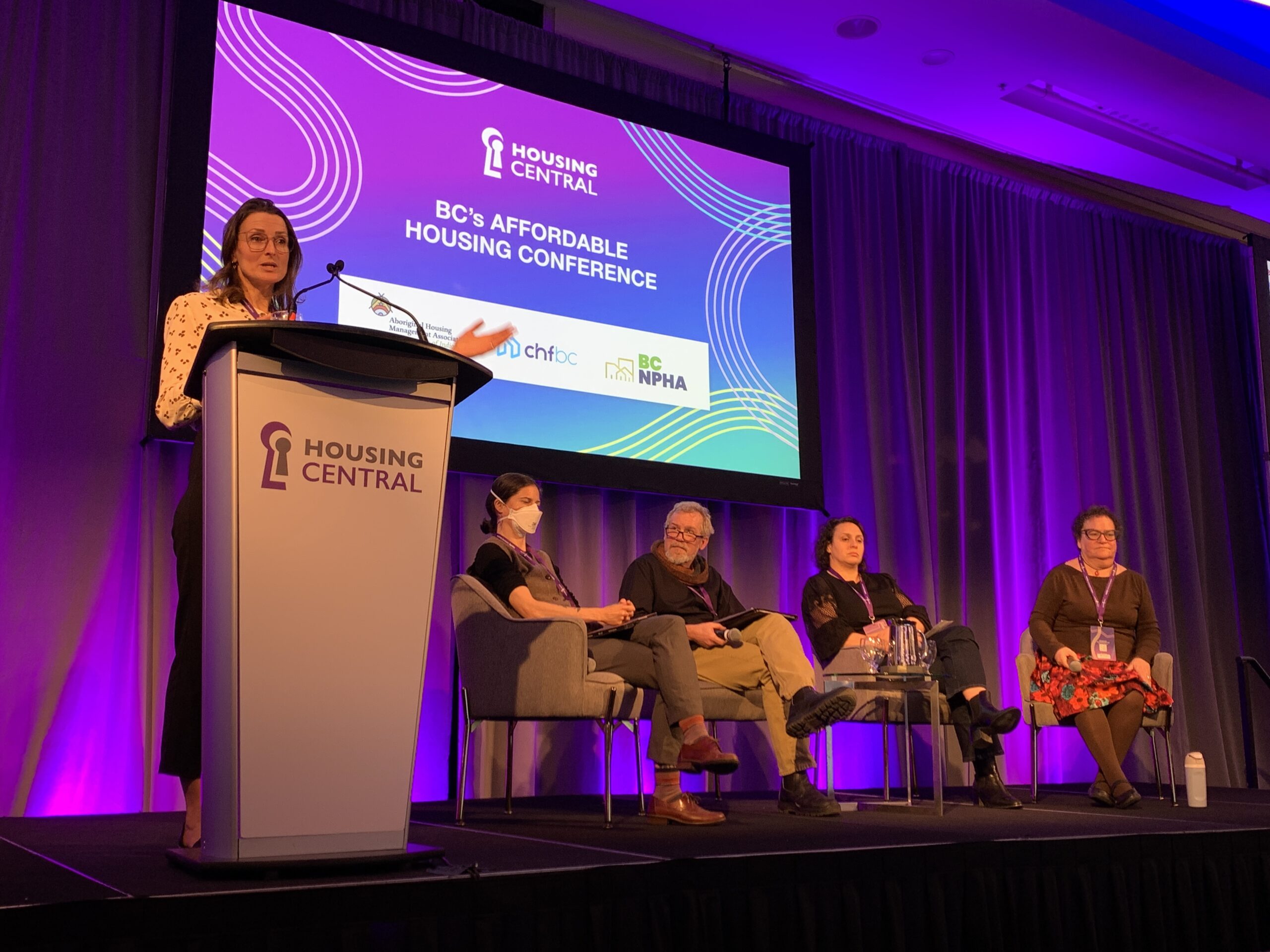
This week, the Balanced Supply of Housing team attended Housing Central, BC’s affordable housing conference—an annual gathering that connects and energizes the sector to continue innovating ways to enable affordable housing in BC and across Canada. With Build Canada Homes now a reality and recent federal budget changes, this is a pivotal moment for advancing everyone’s right to housing. Here are our reflections on what we heard.
Community Land Trusts: Models for Responsive Land Practice
BSH Research Manager Dr. Alina McKay moderated a panel exploring how community land trusts address both land stewardship and housing affordability—central to our work on innovative land practices.
Djaka Blais from Hogan’s Alley Society shared how land trusts can rebuild communities and restore generational wealth lost to displacement. After the destruction of Hogan’s Alley during mid-20th century ‘urban renewal,’ the Society secured a long-term lease to revitalize the neighbourhood. Now operating Nora Hendrix Place and developing new rental housing, their multi-pronged approach demonstrates how land trusts advance both cultural connection and economic opportunity, especially for communities of colour.
Andy Bond from DTES Community Land Trust explained how their work protects affordability in Vancouver’s Downtown Eastside, where SROs face threats from deteriorating conditions and speculation. The DTES CLT is managing buildings like the Keefer Hotel to provide independent, affordable housing while ensuring housing is prioritized for the local community. He emphasized their decolonized governance model as central to how the organization operates, noting: “no one really knows what decolonizing looks like, but we know what we are moving away from.”
Maggie Low highlighted the rising interest in Indigenous Community Land Trusts, which offer Land Back opportunities and stewardship by specific Nations. The CLT model’s flexibility and collectivist ethos align with Indigenous values while protecting stable, affordable housing. This connects to BSH’s research on Indigenous Community Land Trusts, which examines how these models enable Land Back, healing, and housing stability—moving beyond affordability to address systemic issues related to land displacement.
For more on BSH’s Community Land Trust research, visit our series of reports done with the Canadian Network of Community Land Trusts (CNCLT).

Indigenous-Led Development: From Stewardship to Self-Determination
Indigenous-led developments were well represented, starting with a showcase of the Aboriginal Land Trust’s remarkable growth since 2017: $500M in assets, over 200 completed units, and more than 400 underway. Their success stems from a crucial principle—ensuring land is stewarded for future generations rather than solely housing people in the present. The upcoming Indigenous Housing and Healing Centre exemplifies this: housing with integrated services that protects Indigenous heritage.
Dave Ward from Lu’ma Development Management stressed the importance of Indigenous representation in any development. Beyond affordability, building cultural connections across different lived experiences is essential for social sustainability. The Móytel Lalém project demonstrates this vision—a collaboration between the ALT and Swahili Vision International Association sharing cultures between Indigenous people and people of African descent.
Clint Kuzio and William Azaroff from Brightside delivered a compelling conversation on what Land Back truly means for non-profit housing providers. Land Back is about returning land, advancing justice, and being honest about operating on stolen Indigenous land. Brightside developed its Land Back strategy by bringing Indigenous voices into governance and building leadership structures for long-term work. Their advice: organizations must “do their own work first”—examining culture, practicing true inclusion, and preparing themselves before approaching Nations.
This rapid growth connects to BSH research examining how Indigenous Nations are advancing housing on their territories. Our work on mapping First Nations zoning in Metro Vancouver and comparing First Nations-led land and housing regulation models documents how comprehensive land codes enable development models that prioritize cultural connection, intergenerational stewardship, and community self-determination.
Yet gaps remain. BSH’s research on urban Indigenous housing in British Columbia found that although municipalities express commitment to reconciliation, most don’t adequately address urban Indigenous housing needs. Three challenges emerged: lack of resources, ambiguity over whether Indigenous housing needs are distinct, and uncertainty around municipal jurisdiction—underscoring why Indigenous-led solutions are critical.
Centering Indigenous Youth Voices
Bailey Waukey from AHMA presented findings from the Indigenous Youth Housing Strategy, revealing a particularly underserved population. Indigenous youth often experience hidden homelessness and tend not to engage with systems of care—sometimes because seeking help has hurt more than benefited them. Many haven’t been taken seriously by support systems, were children in care who felt neglected, or weren’t supported when asking for help from underfunded services. This lack of data means lack of responsive programming, and youth remain absent from leadership positions.
The strategy centers six principles—Respect, Relationship, Risk-taking, Reciprocity, Relevance, and Rooted—that guide engagement with Young Indigenous Peoples (YIPs). Rather than focusing on personal challenges, the approach emphasizes strengths, prioritizes building rapport before making requests, and offers personalized mentorship while staying grounded in community and its leaders.
For more, listen to our recent podcast on Indigenous-led Housing featuring BSH Director Dr. Alexandra Flynn, Dr. Maggie Low, and AHMA Policy Advisor Bailey Waukey.
Bundling Assets: Scaling Non-Market Housing
A collaboration between UofT’s School of Cities and SHS Innovation explored how housing providers can bundle assets to achieve the scale needed to address the housing crisis. Their message: the community housing sector has what it takes to build at scale but needs momentum that comes from working together.
Three promising examples emerged:
- Community Land Trust Foundation of BC combined City of Vancouver land, Terra Housing development expertise, and Vancity funding to de-risk development and create a sustainable “housing machine” (read our research on CLTFBC for more)
- The Bumblebee Initiative (Ottawa) facilitated consistent processes for Ottawa Community Housing and four supportive housing providers working together
- Plancher (Quebec) demonstrated the need for strong lead organizations, pilot projects, and political champions
The session reinforced that the sector has capacity for this work but needs coordinated momentum and leveraging of diverse organizational strengths.
Understanding Displacement Through Community-Based Research
Mapping SRO Tenancy in the DTES
The Downtown Eastside (DTES) SRO Collaborative, partnering with the City of Vancouver, conducted the most extensive survey of SRO tenants ever—engaging approximately 15% of all DTES tenants. Key findings reveal the deep connection between SROs and homelessness:
- 70% of tenants would be homeless without SROs
- 39% were homeless before securing their unit
- Market SRO rents increased nearly 50% between 2013-2023
- Many tenants have disabilities, physical limitations, or mental health challenges
- 31% of tenants were Indigenous (compared to 2% citywide)
- The 55-64 age demographic grew rapidly (15% in 2008 to 29% in 2023)
- 80% of tenants’ previous housing was in Vancouver—dispelling “bussed in” myths
As Zakir Suleman emphasized: “relationships create richer data”—a resonant sentiment in our own research. This work succeeded through extensive partnerships and tenant empowerment, including Tenant Advisory Committees that met people where they were at. The full report is available here.
Drivers of Eviction in BC
Melissa Giles from BC Rent Bank presented data showing rent arrears as the main eviction driver, with a striking 34% rise in applicants facing 70% income-to-shelter ratios between 2023 and 2024. Five main drivers emerged: employment issues, personal crises, financial crises, health challenges, and housing-specific crises.
Why does this matter? These patterns trigger costly downstream responses. Data-driven evidence, like First United’s eviction mapping project, demonstrates prevention is more effective and less costly than intervening after eviction. Solutions span three timescales:
- Immediate: Strengthen rent banks, improve emergency benefit turnaround, expand mediation services
- Systemic: Develop standardized referral pathways, adopt consistent data collection, ensure trauma-informed services
- Long-term: Increase income support to reflect actual costs, strengthen tenant protections, embed eviction prevention in planning frameworks ch we build.
Gender-Based Violence and Housing Rights
On the conference’s final day, BSH Research Manager Dr. Alina McKay joined a powerful panel with Terri Fortune (AHMA), Amy Fitzgerald (BC Society of Transition Houses), and Haley Hrymak (RISE Women’s Legal Centre). They explored why women-centered housing and rights-focused approaches are critical for addressing gender-based violence and housing insecurity—framing the conversation within both the colonial legacy of the Indian Act that disrupted Indigenous matriarchal structures and Canada’s broader system failures.
AHMA’s Strategy and the Neha Review
Terri Fortune emphasized how AHMA’s Gender-Based Violence Housing Strategy is grounded in human rights frameworks while honoring the activism of women who came before. She highlighted key violations: lack of action on calls to justice for missing and murdered Indigenous women and gender-diverse people, failure to provide culturally appropriate housing, interjurisdictional neglect, and insecurity of tenure.
Terri also spok about AHMA’s submission to the Neha Review Panel—whose name comes from a Kanien’kéha-Mohawk word meaning “our ways”—examines the right to safe, adequate, and affordable housing for women, Two-Spirit, and gender-diverse people through written submissions, oral testimony, and systemic recommendations.
How National Occupancy Standards Create Barriers

Dr. McKay presented findings from BSH’s recent report: Finding Room for Families: Re-Evaluating National Occupancy Standards. This work, part of BCSTH’s submission to Neha, reveals how technical occupancy rules quietly undermine survivors’ access to safe housing.
National Occupancy Standards, introduced in the early 1990s to measure housing suitability, prescribe bedroom requirements based on household composition. When used to match families to social housing, these standards become significant barriers. In a 2022 survey, 96% of BC Society of Transition Houses members reported that NOS negatively impacted the women they serve.
Dr. McKay’s research found the standards routinely force survivors into overcrowded, unstable, or unsafe conditions—revealing how policy design itself becomes a barrier to safety. The recommendation is clear: NOS should be revised to focus on families’ rights to choose housing that meets their needs rather than imposing external standards.
Read our in-depth blog: Creating a Housing System that Works for Survivors of Gender-Based Violence.
The Collapsed Continuum and Legal Barriers
Amy Fitzgerald explained how the traditional pathway from emergency shelters through transition houses to long-term stability has collapsed. With no attainable market housing, survivors become trapped in temporary settings far longer than intended. A women-centered housing model, treating operations as inseparable from design, offers a path forward.
Haley Hrymak presented findings from Should I Have Just Stayed?, documenting how threats, intimidation, economic abuse, and limited housing availability force impossible choices: leave and risk homelessness, or stay in danger. The path forward requires addressing legal and housing systems simultaneously—only by integrating housing stability with family law remedies can survivors safely transition to lives free from coercive control.
For an in-depth look at our petition at the Neha panel, read our blog on Building the Right Supply.
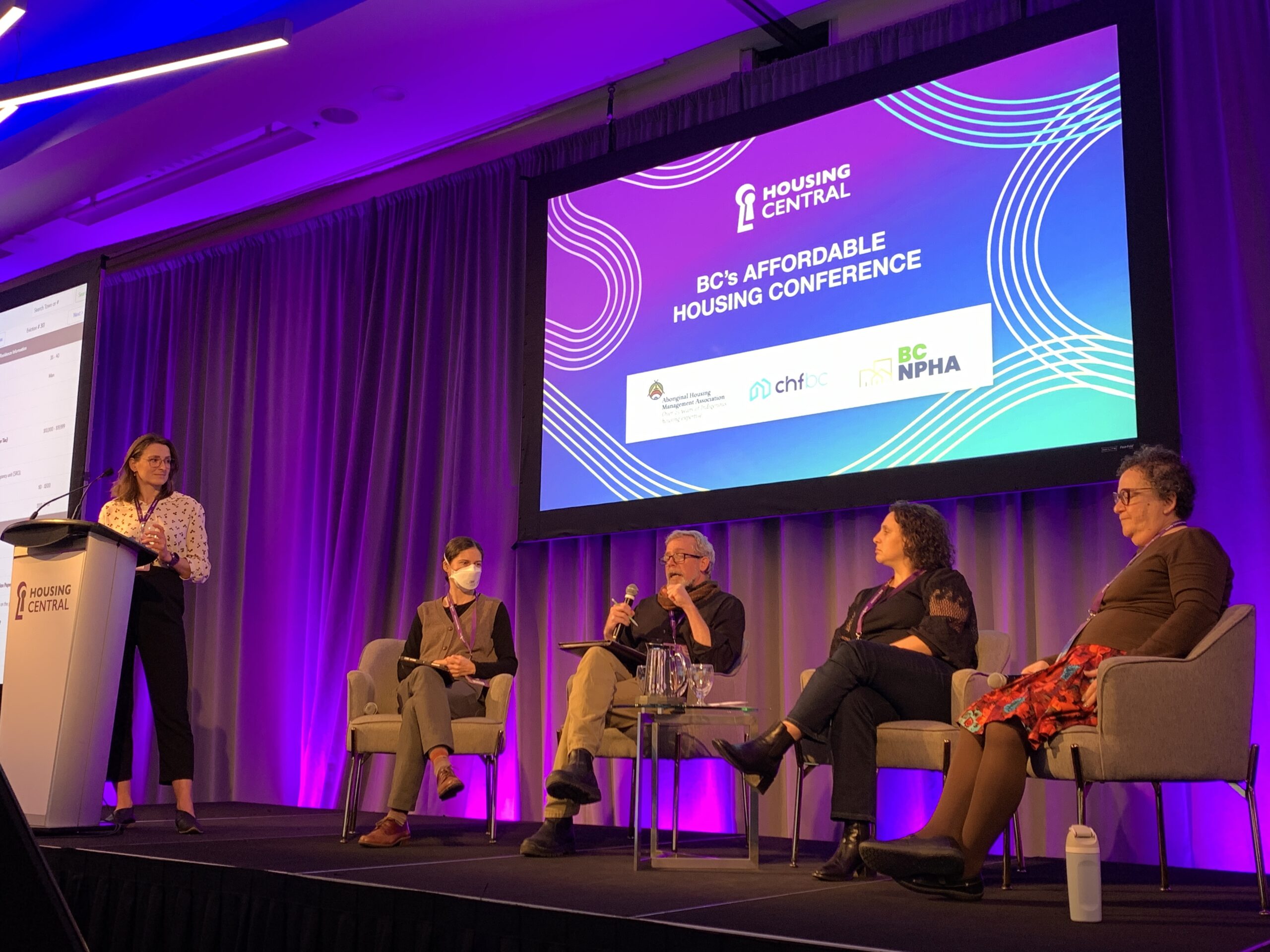
Moving Forward: The National Housing Strategy and What Comes Next
The conference’s final session convened academic researchers including Dr.Carolyn Whitzman (UofT) and Dr. Nathan Lauster with community partners including AHMA’s Research Director, Jena Weber and First United’s Director of System Change and Legal, Sarah Marsden for a forward-looking discussion about Canada’s housing future.
Canada’s housing conversation is shifting, but not nearly fast enough. Across the panel, a clear message emerged: without stronger federal leadership and real accountability, the country will continue managing crisis rather than solving it. Experts stressed that Indigenous housing providers remain sidelined despite decades of chronic underfunding, while outdated federal metrics obscure the true scale of need. Eviction trends and tenant instability—especially for Indigenous renters—underscore how preventable homelessness actually is. Meanwhile, promising developments on First Nations land reveal what’s possible when communities have genuine control, but these successes need to be matched by much larger investments and political will.
The federal budget offered incremental progress, yet panelists widely agreed it falls far short of the moment. Targets are drastically mismatched to need, and signals of potential austerity threaten the supports that actually keep people housed. Municipal resistance continues to impede supportive and non-market housing even where higher governments have opened the door. As Canada approaches the end of its National Housing Strategy, the path forward is clear: scale up proven social housing and prevention models, operationalize the right to housing—especially for Indigenous communities—and confront the fact that our housing outcomes are the result of political choices. Better choices are possible, and urgently needed.
Conclusion
Housing Central reinforced that addressing Canada’s housing crisis requires coordinated action across interconnected domains: land stewardship through community and Indigenous-led land trusts, asset bundling to achieve scale, eviction prevention through evidence-based policy, rights-based approaches centering survivors and marginalized communities, and sustained federal commitment with meaningful targets.
BSH’s research continues supporting these efforts through rigorous community-based work informing policy and systemic change. The path forward is clear, but it requires the political will to implement what we already know works.
The Balanced Supply of Housing is a SSHRC-CMHC funded, community-based research project at UBC that focuses on land use and housing financialization across Vancouver, Toronto, and Montreal.