Assessing the Impact of Short-term Rentals on Canada’s Housing Supply
Last modified:
This project provides the first systematic, evidence-based assessment of the impact of short-term rentals (STRs) on housing supply and affordability.
Jump to Research OutputsWhat impact do short-term rentals have on housing supply and rental affordability in Canada?
This project delivered a general market overview of short-term rentals in British Columbia, including the volume, revenue, type, size and distribution of units, the presence of dedicated commercial operations, and the impact of Covid-19 on the short-term rental (STR) market. It also analyzed the impact of dedicated STRs on housing availability and affordability in BC to determine the impact of commercial STR prevalence on residential rents.
Project Lead(s):
Home Organization:
McGill University
Funding Stream:
Comparative Project
Project Status:
Completed
Background
Policymakers and communities across Canada have been increasingly concerned with the impacts of STRs on housing supply and affordability.
Using a combination of big-data analysis of STR datasets and policy analysis, the project aimed to answer how many housing units have been converted to dedicated STRs across Canada, how the impacts of these conversions can be quantified against local housing metrics, and how many STRs are operating in compliance with relevant local or provincial laws, that is, how many dedicated STRs could be returned to the long-term housing market through better enforcement of existing regulations. It also examined what the COVID-19 pandemic’s extreme shock to STR demand reveals about the longer-term relationship between STRs and long-term housing in Canada.
Methodology
First, the project conducted a general market overview of short-term rentals in the province through a data cleaning process applied to raw STR data via the strr software package and an image recognition algorithm, matchr, used to match listings posted to Airbnb or Vrbo. Second, it analyzed the impact of dedicated STRs on housing availability and affordability in BC through a mixed-effects regression model, which allows for straightforward interpretation of model coefficients.
Results
This project produced a podcast episode, a film screening, and a policy report. Research findings showed that an increase of one dedicated STR per 100 rental units in a neighbourhood predicts a $49 increase in average monthly rents, and that the City of Vancouver registered among the sharpest declines in STR activity during the pandemic. As a result, it is estimated that rents in Vancouver increased 96.8% less in 2020 than they otherwise would have.
Additional research conducted outside the scope of this project can be found here.
Research Outputs
Existing reports, presentation materials, podcasts, webinar recordings, and research summaries.
-
Le Dernier Flip: Screening and Housing Research Panel in Montreal | October 30, 2025
Film Screening and Panel
Learn moreJoin us on October 30, 2025 for a screening of Le dernier flip, a compelling documentary on decommodifying housing, followed by a panel discussion featuring housing BSH researchers.
-
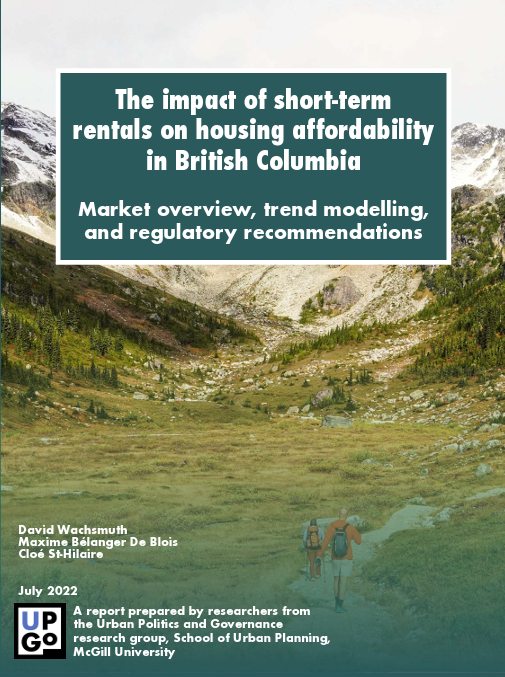
The impact of short-term rentals on housing affordability in British Columbia
Report
Learn moreThis report analyzes short-term rentals (STRs) in the province of British Columbia, with a focus on commercial STRs and their impact on the province’s housing market.
-
Episode 3: Fixing the Housing Market
Podcast
Learn moreWhat can AirBnb and short-term rentals teach us about shaping the housing market and improving affordability?