Moving Forward on the ‘Missing Middle’
Last modified:
This project crowdsources the attitudes toward neighbourhood densification for affordability, choice, and diversity in four major Canadian metropolitan regions.
Jump to Research OutputsWhat does density look like across Canada’s urban centres?
This project advances ‘missing middle’ housing as a critical response to affordability challenges in Canadian cities, examining how regulatory, design, and policy barriers limit the development of mid-density housing forms, such as small multi-unit buildings, and exploring how reforms to planning and building frameworks can enable more flexible, affordable, and context-sensitive housing options. The project extends prior work in Montreal and Toronto to incorporate the Vancouver and Ottawa-Gatineau metropolitan areas, with the focus on generating empirical knowledge and mobilizing why innovative land practices matter.
Project Lead(s):
Home Organization:
McGill University
Community Partner:
Funding Stream:
Comparative Project
Project Status:
Ongoing
Background
‘Missing middle’ housing, including small multi-unit and mid-density forms, has been increasingly recognized as a key solution to housing affordability challenges in Canadian cities. However, its development is often constrained by zoning regulations, building codes, and approval processes that favour either low-density single-family housing or large-scale developments. This creates a gap in housing supply that limits diverse and affordable options within established neighbourhoods.
This project examines these barriers to opportunities for reform that would enable the expansion of missing middle housing.
Methodology
First, this project engages residents to assess attitudes toward infill and development in mature neighbourhoods in Montreal and Toronto, alongside workshops with public-sector actors, particularly in Ottawa, where a new Official Plan with significant densification targets is being implemented.
Second, this project builds on prior work by expanding and deepening analysis of public perceptions of ‘soft densification’ through collaboration with civil society and industry partners, integrating case studies from Vancouver to enable cross-city comparison of responses to different densification scenarios.
Results
This project is currently ongoing and has generated a growing evidence base on the regulatory frameworks, particularly building code requirements and zoning restrictions, that constrain missing middle housing development in Canada. Outputs include journal articles, policy reports, magazine articles, blog posts, a workshop presentation, and a podcast episode.
Research Outputs
Existing reports, presentation materials, podcasts, webinar recordings, and research summaries.
-
What the Suburbs can Teach Us About Designing with Communities
Magazine Article
Learn moreThis article in Ground Magazine takes a deeper look at suburbs—their promise, their potential, and their perspectives. Finding balance between the pros (space, functional living, flexibility) and the cons (ecological footprint, car dependence, infrastructure costs, and rigid regulatory norms), this article looks at suburban spaces with the optimism of possibility.
-

Montreal’s Inclusionary Zoning Debate Reframed: Policy Shifts Under a New Mayor
Learn moreMontréal’s inclusionary zoning policy has transformed under Mayor Soraya Martinez Ferrada. The city replaced its ambitious 2021 “20-20-20” bylaw with a streamlined 20% off-market mandate for large developments. This shift prioritizes simplicity and development incentives over granular affordability targets. This blog explores the policy debate and what this change means for housing affordability and development…
-
Inside Montreal’s inclusionary zoning debate: Who participates and what do they say?
Journal Article in the Journal of Urban Affairs
Learn moreIn 2019, Montréal proposed requiring 40% of new housing units to be below-market rate. This research, which analyzes 147 public submissions from citywide hearings, reveals a predictable split: affordable housing advocates supported the policy while developers opposed it, with both sides echoing existing academic debates about inclusionary zoning’s effectiveness.
-
Le Dernier Flip: Screening and Housing Research Panel in Montreal | October 30, 2025
Film Screening and Panel
Learn moreJoin us on October 30, 2025 for a screening of Le dernier flip, a compelling documentary on decommodifying housing, followed by a panel discussion featuring housing BSH researchers.
-
Episode 13: Non-Profit Housing and Gentle Density
Podcast
Learn moreCanada doesn’t just need big housing plans—we need smart, small-scale solutions. BSH community and academic partners look to examples in Montreal to explain how more non-profit housing and gentle density can boost affordability and supply nationwide.
-
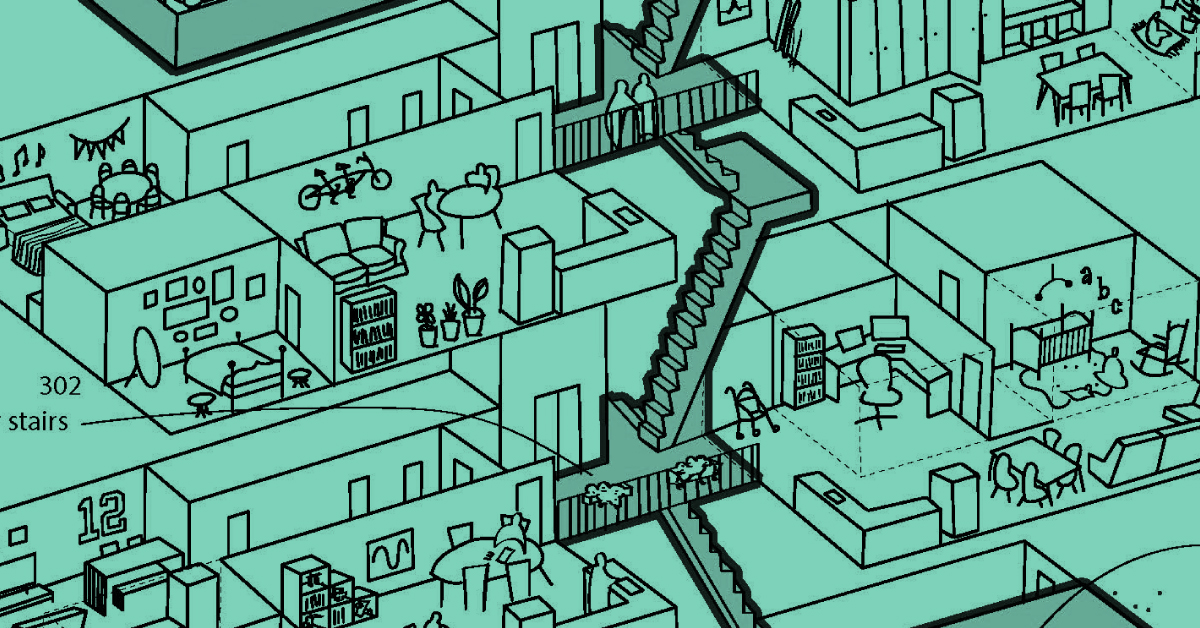
Unlocking Housing Potential Through Design: Reflections on Single-Stair Apartments
Blog post & Event
Learn moreHow does building design impact the way we live and connect within our communities? This question was the focus of a recent Balanced Supply of Housing event in Vancouver, British Columbia, where four experts discussed a significant policy shift permitting single-stair (single egress) apartment buildings in the National building code. In August of 2024, BC…
-
Of homes, domains and boundaries: Immigration and the transitions of Toronto’s modernist suburbs
Journal Article
Learn moreThis research examines immigrant interactions with housing, public spaces, and community-building in Toronto’s “modernist suburbs,” revealing how diverse practices transform urban design and policy.
-
The Second Egress
Website
Learn moreThis website is a tool to make sense of the wicked problem of the second egress in Canada and prepare a building code change:
-

Single Stair Residential Building
Report
Learn moreThis report investigates the benefits to residential construction—unlocked sites and greater floor area, design flexibility, and livability—brought about by code reform allowing for a single-stair exit.
-
Densification urbaines : Pluralités socioécologiques
Workshop Presentation
Learn moreProf. Nik Luka spoke on urban densification at a day-long public workshop jointly hosted by McGill University and the Office de consultation publique de Montreal.