
Strengthening Community Land Trust Research
Improving resources for expanding CLTs in Canada
Last modified:
This interdisciplinary project aims to better understand the structural role of Community Land Trusts (CLTs) in the Canadian housing landscape.
Jump to Research OutputsWhat role can CLTs play in the Canadian housing landscape?
This project brought together interdisciplinary studies to strengthen CLT research across Canada, focused on key issues identified by the CLT sector. The research has contributed to furthering discussion about the role of CLTs in protecting affordability and creating inclusive communities.
Project Lead(s):
Home Organization:
University of British Columbia
Other Participants:
Community Partner:
Aboriginal Housing Management Association, BC Non-Profit Housing Association, BC Society of Transition Houses, Canadian Network of Community Land Trusts, Parkdale Activity and Recreation Centre
Funding Stream:
Community-Focused Project
Project Status:
Ongoing
Background
Community land trusts (CLTs) are a form of land stewardship rapidly growing across Canada. Typically, CLTs are community-run organizations, governed by a tripartite board, that own, develop, and manage land and buildings to benefit the local area. This unique approach to land stewardship has garnered significant interest as an effective alternative to maintain long-term property affordability and foster community building.
Methodology
The project addressed three research questions:
First, what role do CLTs play in responding to gentrification? Susannah Bunce (UofT) and PhD student Emma Ezvan developed a paper exploring this question with a focus on the City of Toronto.
Second, what are the implications of potential policy and zoning changes in Vancouver for CLT efforts to preserve low-income housing? Kuni Kamizaki (UBC) is working in partnership with the Downtown Eastside (DTES) CLT to understand how policy changes led by Vancouver City Council will affect the preservation and replacement of single room occupancy (SRO) housing, the primary source of low-income housing in the DTES. The DTES CLT has been working to preserve SROs in moderately good condition, which remain susceptible to conversion and gentrification-by-upscaling; this research explores the implications of policy and zoning changes currently being explored by Vancouver City Council for the Oppenheimer District, which have historically protected the area from new condominium development, curbed speculation, and limited displacement.
Third, is a Canadian legal definition for CLTs needed? Alexandra Flynn (UBC) and law student Meagan Auger (UBC) worked with CNCLT to review Canadian and international law on how it applies to CLTs, given the wide variety of financial, organizational, and governance structures CLTs use in Canada. The resulting report is part of the CLT Report Series presented at the CNCLT Summit in October 2024, alongside a toolbox of common questions CLTs face.
Additional reports related to CLTs can be found on our Policy Report and Profile Series on Canadian Community Land Trusts project page (https://bsh.ubc.ca/research/policy-report-profile-series-on-canadian-community-land-trusts/
Results
This project has generated a growing evidence base on the structural role of CLTs in the Canadian housing landscape, including policy reports, a capacity building workshop, and blog posts that inform the development of CLTs and support long-term affordability.
Research Outputs
Existing reports, presentation materials, podcasts, webinar recordings, and research summaries.
-
Episode 19: When Policy Pauses Public Ownership
Podcast
Learn moreWe’ve spoken a lot about community land trusts in our podcast series, and it’s been gaining momentum in cities and towns all over Canada. Listen to this podcast as we bring you two cases from Vancouver to hear about how some policy choices are stalling some land trust projects and how these barriers can be…
-
Community Land Trusts Are Building Momentum. Here’s Why That Matters.
Learn moreMay 15th marks World CLT Day. Learn about our CLT partners’ recent strides in expanding innovative land use models to better meet the needs of their communities.
-
From the Ground Up: How Parkdale Built a Community Land Trust
Learn moreDr. Kuni Kamizaki’s Metcalf report chronicles Parkdale Neighbourhood Land Trust’s evolution from grassroots organizing to land acquisitions. Learn how this CLT used flexible funding, democratic governance, and community planning to influence Toronto policy, combat displacement, and preserve affordability—offering a practical roadmap for communities fighting gentrification and the housing crisis.
-
Vancouver’s Downtown Eastside Upzoning: A Policy Out of Balance
Blog Post
Learn moreVancouver City Council approved sweeping Downtown Eastside zoning changes in December 2025, slashing social housing requirements from 60% to 20% while allowing density to more than double. Read on for our analysis on the contradictory policies—upzoning one vulnerable neighbourhood while blocking social housing citywide—and learn about evidence-based strategies to prevent displacement in one of Canada’s…
-
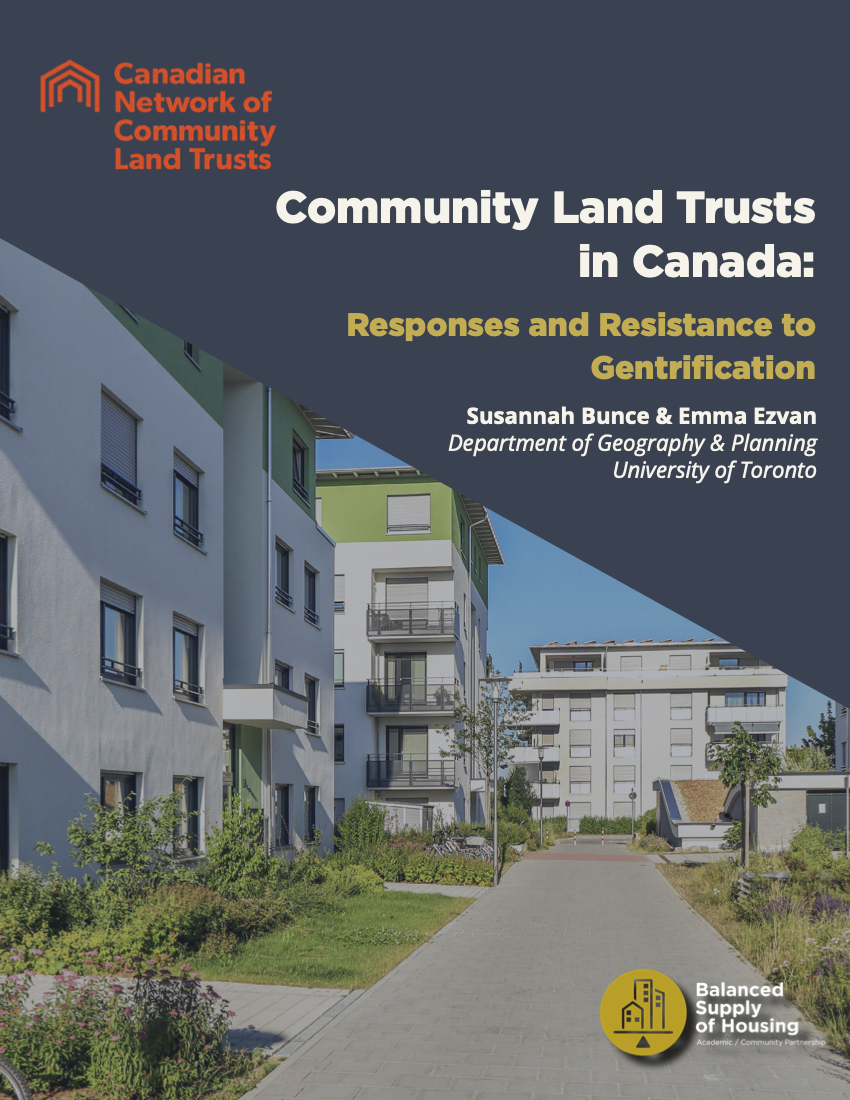
Responses and Resistance to Gentrification
Report
Learn moreThis report examines how Canadian Community Land Trusts (CLTs) resist gentrification by decommodifying land, promoting community ownership, and ensuring long-term affordability, countering the displacement and transformation caused by profit-driven development.
-
CLT Definitions
Report
Learn moreThis paper examines the legal definitions of CLTs worldwide to inform the possible development of a legal definition for CLTs in Canada and how a legal definition might impact their work at the community level. Written by Meagan Auger, J.D. from the Peter A. Allard School of Law at UBC.




Alert the presses!
This project hasn’t hit the news yet.