
Who Owns Chinatown?
Mapping Ownership and Precarity to Mobilize a Community Land Trust
Last modified:
This project identifies existing affordable housing stock in downtown Chinatown that is vulnerable to speculation, upscaling, and eviction threats, and develops community-led strategies for housing preservation and acquisition through a community land trust.
Jump to Research OutputsWhich housing assets in Toronto’s Chinatown are vulnerable, and how can a community land trust support their preservation?
This project builds on grassroots organizing in Toronto’s Chinatown to identify existing affordable housing and explore how community-controlled ownership models can protect it, focusing on mapping ownership patterns and housing precarity to support the development of a community land trust (CLT).
Project Lead(s):
Home Organization:
University of Toronto
Other Participants:
Community Partner:
Friends of Chinatown Toronto (FOCT)
Funding Stream:
Community-Focused Project
Project Status:
Ongoing
Background
Friends of Chinatown Toronto (FOCT) is a grassroots group organizing for community-controlled housing and racial justice in Toronto’s downtown Chinatown. Since 2019, FOCT has explored the CLT model, and in 2020 partnered with University of Toronto planning students on a research report outlining strategies, including the CLT model, for combatting displacement pressures. Building on that project and ongoing neighbourhood organizing, this project identifies existing affordable housing stock in downtown Chinatown that is vulnerable to speculation, upscaling, and eviction threats, and develops community-led strategies for housing preservation and acquisition across housing types through a CLT.
Methodology
First, the project will take a community action research approach that combines secondary data collection, including changes in rents, property ownership, housing types, and evictions, with tenant surveys conducted through canvassing and phone outreach. Second, it will map assets held by Chinatown’s family associations, benevolent societies, and faith-based organizations, which have long offered housing and essential services to immigrant and racialized community members, an approach that also builds relationships with long-term property owners to preserve affordable housing, a strategy previously used by Boston’s Chinatown CLT. Third, the project will organize two to three focus groups with FOCT members and community stakeholders to collectively analyze data and generate community-led acquisition strategies and policy options.
Results
The project is currently ongoing and has resulted in outputs such as a research webinar and blog post. A public-facing report is forthcoming.
Research Outputs
Existing reports, presentation materials, podcasts, webinar recordings, and research summaries.
-
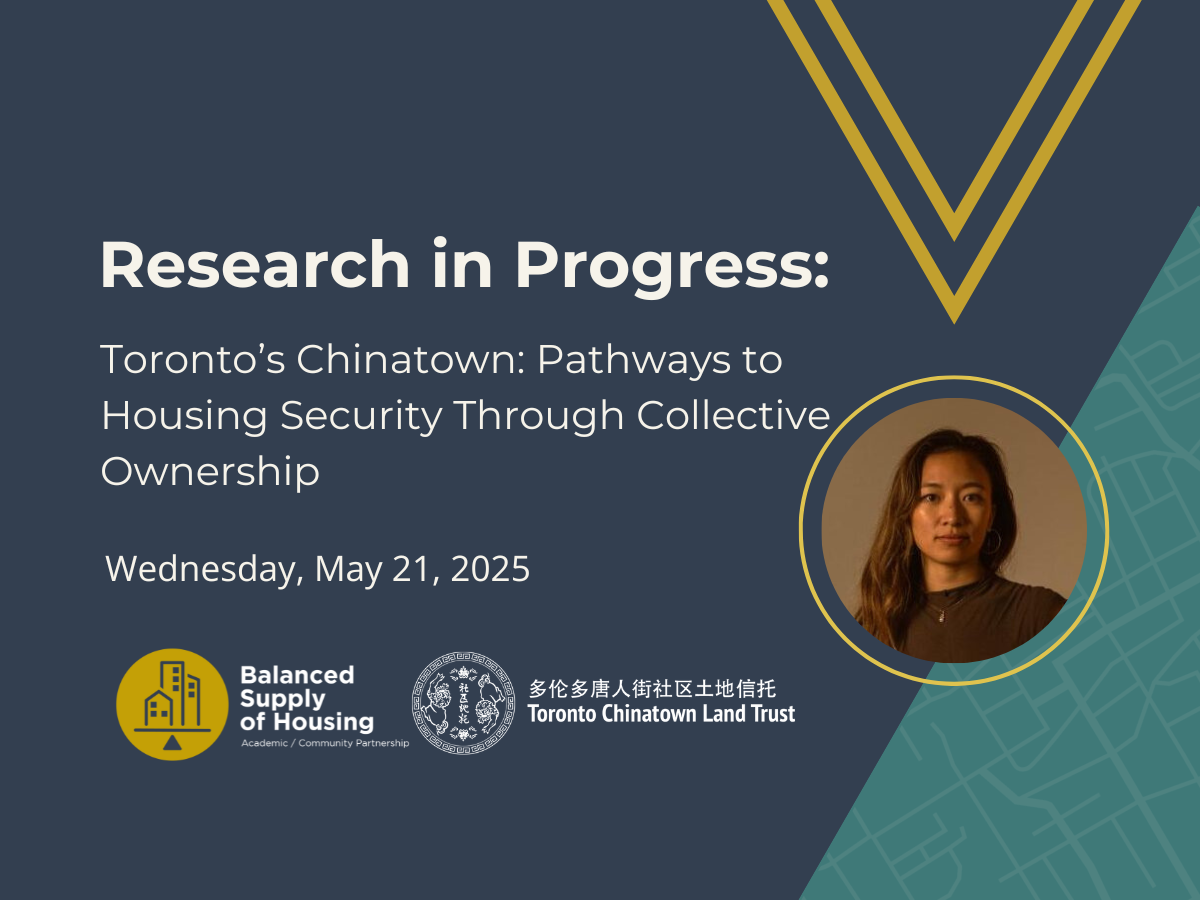
Research in Progress on Housing Security Through Collective Ownership in Toronto’s Chinatown
Research in Progress Webinar
Learn moreJoin us for a presentation on how the Community Land Trust model supports affordability, cultural heritage, and long-term community stability.
-

Alert the presses!
This project hasn’t hit the news yet.