
Studying Montreal’s Financialization of Multi-Family Rental Housing
Spatiality, local specificity and empirical methodology
Last modified:
This project analyzed the financialization of Montreal’s multi-family rental housing sector and developed a reproducible empirical framework for studying financialized landlords within a specific urban geography.
Jump to Research OutputsWho own’s Montreal’s rental stock?
This project combined datasets on landlord ownership, property assessment, and census data in Montreal to develop empirical approaches for studying housing financialization at the city scale. Existing methods tend to focus on specific financial actors, segments of the housing sector, or individual building types, such as REITs or pension funds on a slice of the housing sector, limiting broader analysis. Through an open-source approach, this project developed a reproducible framework for identifying, measuring, and analyzing the presence and impacts of financialized landlords across an urban housing market.
Project Lead(s):
Home Organization:
McGill University
Other Participants:
Community Partner:
Regroupement des comités de logements et associations de locataires du Québec
Funding Stream:
Community-Focused Project
Project Status:
Completed
Background
This project addressed a gap in understanding the financialization of rental housing at the city scale in Canada. Existing studies are limited in geographic scope, and no comprehensive portrait currently exists of the dynamics of financialization in a Quebec metropolis.
This project had a two objectives: first, to developed a detailed portrait of the financialization of Montreal’s multi-family rental housing sector by examining ownership evolution and landlord types, and by mapping the economic geography of financialized landlords across the city; and second, to highlight the local specificities of Montreal’s rental financialization, enabling future comparative research with other Canadian cities.
Methodology
First, this project combined a literature review on financialization with a discourse analysis of financial actors in Montreal to examine their strategies within the city’s rental housing market, integrating multiple datasets to map the economic geography of financialized landlords and quantify their presence.
Second, it developed a methodological framework for empirically studying financialization within a defined geography, providing a reproducible approach that can support analysis and policy research in other urban contexts.
Results
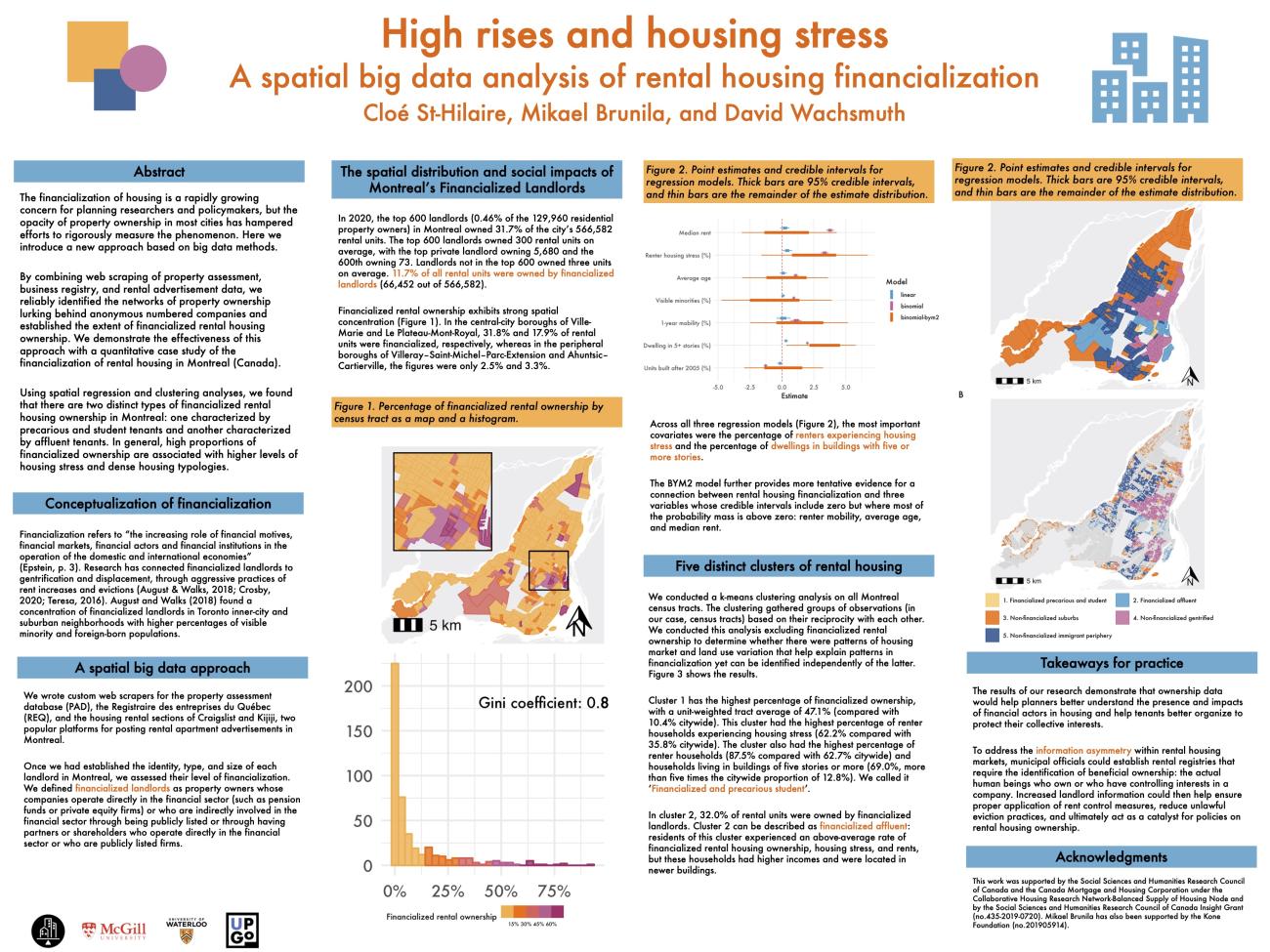
The project has resulted in a variety of outputs such as a film screening, a journal article and a poster presentation. The project finds that there are two distinct types of financialized rental housing ownership in Montreal: one associated with precarious and student tenants, and another associated with more affluent tenants. It also shows that higher levels of financialized ownership are linked to increased housing stress and are concentrated in denser housing typologies.
Research Outputs
Existing reports, presentation materials, podcasts, webinar recordings, and research summaries.
-
Le Dernier Flip: Screening and Housing Research Panel in Montreal | October 30, 2025
Film Screening and Panel
Learn moreJoin us on October 30, 2025 for a screening of Le dernier flip, a compelling documentary on decommodifying housing, followed by a panel discussion featuring housing BSH researchers.
-
High Rises and Housing Stress
Journal Article
Learn moreA quantitative case study of the financialization of rental housing in Montréal.
-


Alert the presses!
This project hasn’t hit the news yet.