
On November 4, the federal government released Budget 2025 with $25 billion in new housing measures—including $13 billion over five years for Build Canada Homes. Here’s our analysis of what they got right, where improvements are needed, and what this means for the sector.
What They Got Right
Supportive and Transitional Housing Investment
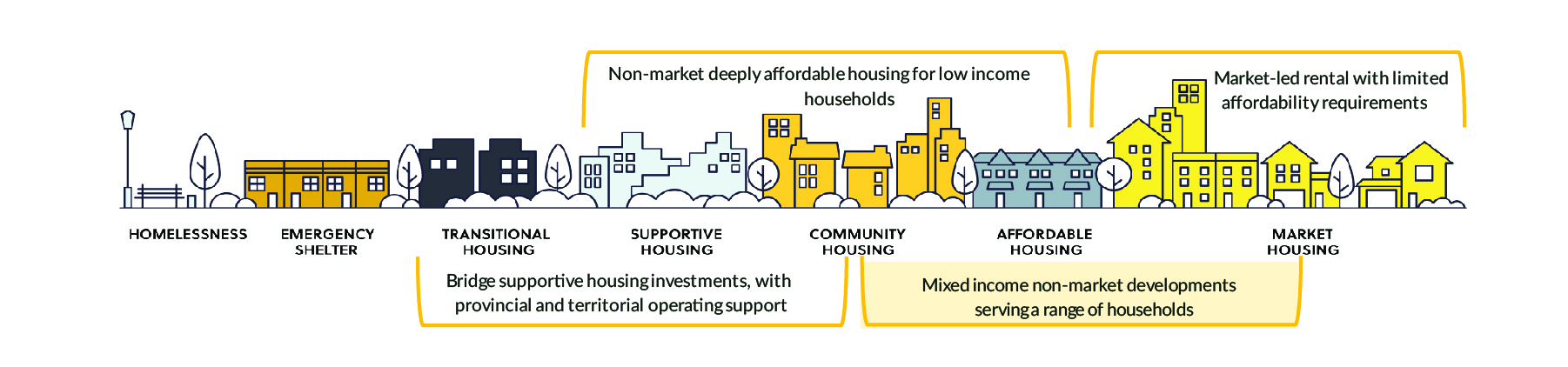
The government had already announced funding for a key ask with $1 billion dedicated specifically to transitional and supportive housing for people who are homeless or at risk of homelessness. This is exactly the type of targeted investment we called for, recognizing that housing must be tailored to the people who need it.
This funding will be deployed through Build Canada Homes in collaboration with provincial, territorial, municipal, and Indigenous partners to pair federal investments with employment and healthcare supports. This coordinated approach is critical—bricks and mortar alone won’t solve deep housing insecurity and homelessness without the necessary wraparound services. As part of this work, it’s also critical to consult with the non-profit sector to identify national definitions of supportive housing and transition housing to ensure the funding goes to evidence-based solutions that meets housing need at the community level.
Protecting Existing Affordable Housing
We called for continued investment in the Canada Rental Protection Fund. The government responded in last month’s announcement with $1.5 billion to support the community housing sector in acquiring at-risk rental apartment buildings. This preservation strategy ensures that we’re not just building new affordable housing while losing existing units to market pressures.
Build Canada Homes has a mandate “to grow the supply of affordable and non-market housing—not only by building new homes, but also by preserving the ones on which Canadians already rely.”
Infrastructure Investment
The new Build Communities Strong Fund represents a massive commitment—$51 billion over 10 years to address infrastructure gaps. This includes housing-enabling infrastructure like roads and water/wastewater systems.
Critically, to access these funds, provinces and territories must agree to cost-match federal funding and substantially reduce development charges, which is a key barrier to affordable housing development. We are in favour of relieving the pressure on municipalities that forces them to charge high development charges in the first place, however it does not meet campaign promises of cutting municipal development charges in half.
Indigenous Housing Commitments
Build Canada Homes will partner with the Nunavut Housing Corporation to build over 700 public, affordable, and supportive housing units. The budget commits to working with First Nations, Inuit, and Métis leadership to determine how Build Canada Homes can best contribute to Indigenous-identified needs and priorities, including $19 billion for Indigenous and Municipal Infrastructure over 5 years.
Additionally, the budget confirms $2.8 billion in funding for urban, rural, and northern Indigenous housing, building on efforts to address acute housing needs in Indigenous communities. Our work on Urban Indigenous housing and First Nations-led land and housing regulation can help guide these necessary conversations.
Non-Market Housing Focus
The budget recognizes Build Canada Homes’ role in building non-market housing, including a significant expansion of cooperative housing through the Co-op Housing Development Program, the largest investment in co-op housing in 30 years, which has already allocated $423 million to support eight new co-op buildings with 837 new homes. Community land trusts are not explicitly mentioned in the budget, however, they are an important and transformative non-market housing solution offering affordable rents, in perpetuity.
Source: Budget Canada 2025
Where Additional Improvements Are Needed
Long-Term Financing Clarity for Non-Profit Providers
While Build Canada Homes represents a structural shift in how the federal government approaches housing, specific details about long-term financing mechanisms for non-profit and Indigenous providers remain opaque. The budget emphasizes that Build Canada Homes will “deploy capital” and use “bulk procurement and long-term financing,” but more transparency is needed about:
- How non-profit providers can access this capital
- What terms and conditions will apply
- How the government will ensure these financing mechanisms are truly accessible to smaller community-based organizations
The increase in Canada Mortgage Bond annual issuance from $60 billion to $80 billion focuses on multi-unit housing, which could support rental construction, but it’s primarily aimed at private market development through mortgage loan insurance and securitization.
Renter Bill of Rights and Security of Tenure
We called for a coordinated approach to protecting security of tenure and funding to support a Renter Bill of Rights. This is notably absent from Budget 2025. BSH researchers Silas Xuereb and Craig Jones found that more than half of evictions between 2016 and 2021 were “no-fault,” meaning that the tenant was evicted due to landlord factors, including sale of property, the landlord moving into the unit, or renoviction. While the budget makes significant supply-side investments, it doesn’t address the immediate and ongoing protection needs of current renters facing renovictions, aggressive rent increases, and housing insecurity. We continue to advocate for these urgent measures to avoid the self-perpetuating and devastating impacts of evictions on people’s lives.
For more of our research on evictions and security of tenure, see our Filling the Gaps and Estimating No-Fault Evictions work.
Homelessness Funding Beyond Supportive Housing
While the $1 billion for supportive and transitional housing is significant, Budget 2025 lacks dedicated funding for broader homelessness initiatives and emergency responses. The budget focuses heavily on construction and supply, but homelessness is a multi-faceted crisis that requires immediate, comprehensive action beyond building units.
Research through our parent project, UBC’s Housing Research Collaborative, has documented the lived realities of people experiencing homelessness. Our work on human rights and tent encampments has shown that people experiencing homelessness face displacement without dignified alternatives, and that their property rights are routinely violated. These findings underscore a critical gap: housing justice requires protecting the rights and dignity of people who are currently unhoused, not just building homes for the future.
Federal Housing Advocate and National Housing Council Funding
The National Housing Strategy Act (NHSA) recognizes housing as a fundamental human right and establishes accountability mechanisms, including the Federal Housing Advocate and National Housing Council—the bodies responsible for monitoring the right to housing and holding governments accountable. Yet without dedicated homelessness funding and resources for these oversight bodies, the government cannot fully realize its human rights obligations under the NHSA. This specific commitment is not visible in Budget 2025.
Given the scale of investment proposed, robust oversight and accountability mechanisms are more important than ever. Without adequate funding for these monitoring bodies, we risk losing sight of whether these investments are actually reducing homelessness and core housing need.
Balanced Geographic Development
While we called for infrastructure investment to ensure housing can be developed in areas that are centrally located and close to amenities, the budget’s approach to location and transit-oriented development could be stronger. The Build Communities Strong Fund includes infrastructure like roads and transit, but specific commitments to prioritizing mixed-use, transit-accessible developments are unclear.
Key Takeaways for the Sector
A Structural Shift to Address Urgent Need
Build Canada Homes represents more than new money—it’s a fundamental reorganization of how the federal government approaches housing. It consolidates programs like the Housing Accelerator Fund, Apartment Construction Loan Program, and federal lands initiatives under one agency. This could mean:
- More streamlined application processes (but we need to monitor whether it actually reduces red tape or creates new bottlenecks)
- Greater coordination between different funding streams
- Addressing the urgent need for faster deployment of capital
The Capital Budgeting Framework Allows for More Flexibility
Budget 2025 introduces a new capital budgeting framework that reclassifies housing investments as long-term capital rather than annual program spending. This means Build Canada Homes will have more flexibility to spread project funding over multiple years and draw in private and institutional investors
This is significant because it could unlock patient capital and longer financing terms—exactly what non-profit providers need. However, we need to ensure this flexibility extends to the non-profit sector, not just private developers.
Speed and Scale Expectations
The government has set ambitious targets: doubling the pace of construction from 280,000 homes per year to between 430,000 and 480,000 homes per year. Build Canada Homes is described as having “a mandate to move quickly.”
For the sector, this means:
- Capacity building is urgent: Organizations need to scale up quickly
- Workforce development is critical: The budget acknowledges the need to expand the skilled construction workforce
- Innovation adoption matters: The emphasis on factory-built, modular, and mass timber construction methods (with potential to cut timelines by 50%, reduce costs by 20%, and lower emissions by 20%) means providers should explore these approaches
Public Lands Prioritization
Build Canada Homes announced plans to develop public land sites, starting with six sites to build 4,000 factory-built homes, with additional capacity of up to 45,000 units across Canada Lands Company’s portfolio. Non-profit providers must be a partner on these public lands opportunities to ensure the right supply of housing is built.
Our Key Takeaways
Budget 2025 affirms the kind of housing that Canada needs—supportive housing, transitional housing, and protected affordable rentals. The $1 billion for supportive housing and $1.5 billion for the Canada Rental Protection Fund directly answer our asks.
However, this budget does not address tenant protection and homelessness. The absence of a Renter Bill of Rights, unclear long-term financing details for non-profits, and insufficient funding for housing rights oversight represent significant gaps.
The test will be in implementation. Build Canada Homes has the potential to be transformative if it truly prioritizes non-market and deeply affordable housing, provides accessible financing to non-profit providers, and maintains accountability to housing rights principles.
We’ll be watching closely to ensure that:
- Non-profit and Indigenous housing providers have genuine access to Build Canada Homes financing
- “Affordable housing” definitions remain stringent and tied to actual housing need
- Supportive housing investments are paired with adequate operating funding from provinces and territories
- Infrastructure investments prioritize complete communities with amenities and transit access
- Accountability mechanisms ensure these investments reduce homelessness and core housing need
The housing and homelessness crisis demands a “Team Canada” approach, as the Canadian Alliance to End Homelessness noted. Budget 2025 opens that door. Now we need all orders of government to walk through it together—with the non-profit sector as a full partner in delivery.
We encourage organizations in the housing sector to review the full budget details at budget.canada.ca and follow Build Canada Homes as implementation details emerge. We’ll continue advocating for the improvements needed to ensure this generational investment delivers truly affordable, deeply affordable, and supportive housing for all who need it.
The Balanced Supply of Housing is a SSHRC-CMHC funded partnership grant led by Dr. Alexandra Flynn at UBC’s Allard School of Law that focuses on land use and housing financialization across Vancouver, Toronto, and Montreal.